Zircon Industry Association, 24 Old Bond Street, Mayfair, London W1S 4AP, UK
Twenty-plus interviews. A dozen frameworks. One year. That's what it took ZIA ESG consultant Sarah Hoang to answer a question that's been quietly shaping the zircon industry's sustainability agenda: why do some companies dive into ESG reporting while others struggle to get off the ground?
Sarah joined the Zircon Industry Association with a background in international economics and a growing curiosity about ESG. What started as an internship project turned into a year-long deep dive across the zircon value chain — interviews with more than 20 industry stakeholders, hours of conversation, and a picture of the industry that turned out to be more nuanced than anyone expected.
The first thing Sarah's research made clear: there's no single "ESG reporting challenge" facing the industry. There are two, and they pull in opposite directions.
On one side are companies just getting started - often smaller businesses without dedicated ESG teams or deep in-house expertise. They're motivated, but overwhelmed. Where do we even begin? What actually needs to be reported? How do we build the confidence to collect and disclose meaningful data? For this group, the barrier isn't willingness - it's know-how.
On the other side are the industry's more mature reporters. They've built the processes, hired the people, and ticked the compliance boxes - and now they're drowning in a different problem: reporting fatigue. Some told Sarah they're reporting against more than 20 different frameworks at once. Mining companies in particular often juggle overlapping obligations across multiple commodities and markets. For these companies, more guidance isn't the answer. Less duplication is.
For years, the instinct across the industry was to add: another certification, another standard, another disclosure scheme, just in case a customer or stakeholder asked for it. Sarah's research suggests that instinct is starting to reverse.
Instead of chasing every available framework, companies are beginning to consolidate - focusing on the certifications that genuinely matter to their stakeholders and customers, and quietly retiring the ones that don't. It's less about doing more ESG, and more about doing the right ESG.
That shift shaped Sarah's two headline recommendations for the industry:
The research itself is only half the story. Sarah says the project reshaped her as much as it informed the industry. Interviewing senior executives pushed her communication and confidence further than a classroom ever could. Running a project that spanned more than a year sharpened her organisational and analytical instincts in ways she didn't expect.
“It's completely different from a university case study,” Sarah reflects. Real companies, real stakes, and mentorship from industry professionals who'd actually lived the problems she was researching - that combination, she says, is what made the work feel meaningful rather than theoretical.
Sarah's study doesn't offer a one-size-fits-all fix - and that's rather the point. It's a reminder that ESG reporting isn't a single ladder every company climbs at the same pace. Some members need a hand up. Others need help decluttering. Either way, the goal is the same: keeping ESG reporting practical, meaningful, and genuinely achievable across the zircon supply chain.
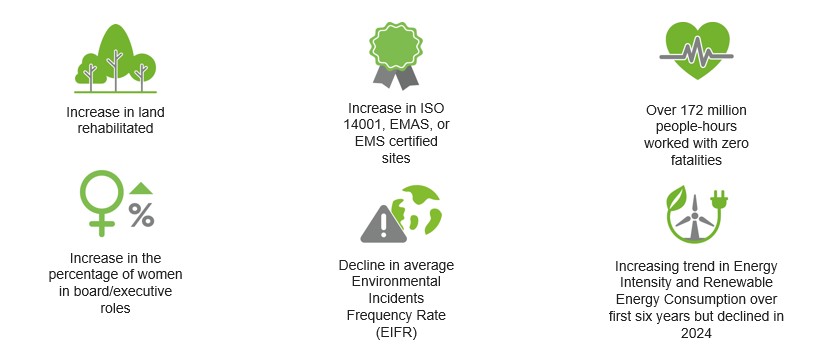
ZIA publishes annual ESG zircon industry reports. Beginning in 2021, the data were collected for the period 2018- 2024, against 20 Key Performance Indicators. ESG summary reports are available here.
Notable trends between 2018 – 2024 were as follows: